Fear of snakes: An evolutionary perspective on the way kids learn
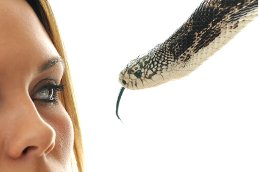
© 2022 Gwen Dewar, Ph.D., all rights reserved
Know a child with a disgust or fear of snakes?
How most a fearful toddler? Or babe?
People aren't born with such responses. We know that from experiments on infants. If you bear witness snakes to 7-month old babies, they don't act frightened at all.
How—and when—practise these fears first appear?
According to the thought of classical workout, people and other animals go frightened of a thing if they've experienced something nasty (like a shock) each time they encounter it.

Just this process seems inefficient. Does a monkey demand to get attacked in order to learn a fear of snakes?
If then, how many monkeys would survive to adulthood?
So the reality is this: Animals have ways of learning about unsafe things that don't depend on first-hand experience. They tin acquire about predators by watching other members of their ain species.
When a group of monkeys encounter a snake, the babies and juveniles lookout how the adults react. They learn to cry out, to warning other members of their family unit, to go out of the snake's reach. They learn to exist afraid.
That's fascinating enough. Humans aren't the only creatures that pass cognition from parents to offspring.
But there's even more going on, and information technology concerns the way human children learn about danger:
Our brains might come up equipped with special mechanisms that help united states of america learnmore apacevirtually certain kinds of animals—the animals that have posed the greatest threats to our ancestors.
40 years ago, Martin Seligman proposed the thought that animals are "prepared" to larn some lessons very fast.
I example concerns potentially poisonous foods. Ever observe what happens if you happen to feel ill (and vomit) after eating a new nutrient? You don't want to try information technology over again. For some people, it takes merely one bad experience to acquire this lesson—whether or not the nutrient actually is to blame.
Perhaps snakes and spiders are like that. Maybe it takes very lilliputian to trigger our fear or cloy. We come across friends or family act fearfully, and nosotros're persuaded. Nosotros don't demand a lot of time for the lesson to sink in. Our brains see a ophidian, receives the social input and says "Oh yes, your friends are right–those things are BAD."
Where'southward the evidence? Fast forward to the 1980s, when Michael Cook and Susan Mineka (1989) conducted archetype experiments on captive rhesus monkeys.
These primates had never been in the wild, and they'd never before seen a ophidian. If y'all showed these monkeys a toy snake, they didn't react fearfully.
So the researchers tried this. They divided the monkeys into two groups, and showed each group a different "chilling" video:
- Group One watched a video of a monkey acting frightened of a plastic flower.
- Group Two watched a video of a monkey interim frightened of a plastic snake.

The videos had been carefully edited to make it appear that the protagonist was equally fearful of both objects.But the videos were non equally effective.
If, later on watching these videos, y'all gave a monkey a plastic flower, he wasn't likely to react. But if you gave him a plastic snake, he showed fear.
In a like experiment, monkeys quickly learned to fright a toy crocodile merely non a toy rabbit.
The results were exciting. The monkeys had adult a fright of snakes(and crocodiles) afterward a few, cursory experiences watching another monkey on TV. It wasn't a general response to social cues considering the monkeys seemed relatively resistant to "communicable" a fear of flowers or rabbits.
And it made sense that primates might have evolved specialized brain mechanisms for learning to fearfulness snakes and crocodiles.
Snakes and crocs impale primates, and have done and so for millions of years. So spotting these predators was a high-stakes game. And when the stakes are high enough, individuals who are quick to trust social cues about predators have a fitness advantage (Dewar 2003).
But what almost man primates? Is there any evidence that human children are "prepared" past natural selection to learn that snakes are dangerous?
Detecting snakes in the grass
Kid psychologists Judy DeLoache and Vanessa LoBue have found that American preschoolers are good "snake detectors."
If you bear witness three-year-olds a set of eight photographs—seven depicting caterpillars and i showing a snake—they are pretty quick to find the snake. By contrast, they take longer to find the caterpillar in a grouping of snake photos. The same thing happens when you lot inquire kids to distinguish snakes and frogs. Picking out snakes seems to beeasier(LoBue and DeLoache 2008).
DeLoache and LoBue take too tested the style babies—some as young every bit 7 months old–react to snakes and the sound of human fear (Deloache and LoBue 2009).
In 1 experiment, the researchers established that babies don't answer appallingly to the sight of snakes. Non if the snakes are on video and the babies aren't given any social hints that snakes are scary.
Side by side, the researchers asked a different question: Do babies respond differently to snakes if they hear adults sounding fearful?
To find out, LoBue and DeLoache presented 48 infants with a special "serpent show."
Each baby sat with his or her mother while 2 silent videos—running next—played simultaneously. One video showed an undulating snake. The other video depicted a non-snake moving at approximately the aforementioned speed. The moms were blindfolded and so they couldn't give their babies any cues.
Babies watched videos for a total of 12 trials—each trial pairing a unlike serpent video with a video of a unlike non-snake (giraffe,rhinoceros, polar bear, hippopotamus, elephant, and large bird).
And here's the important office. In one-half the trials, the videos were accompanied by an auditory rails of an developed speaking in frightened tones. In the remaining trials, the videos were paired with a happy adult vocalization.
When given the selection, which videos did the babies scout?
It depended on the context.
When the videos were accompanied by the sound of an adult'south fearful vocalism, the babies spentmore time looking at the snake video.
When the videos were matched with the sounds of a happy voice, babies didnot pay any special attending to the snake.
The mounting bear witness for evolutionary biases
Have scientists demonstrated that there are specialized "snake-detectors" in the brain? Can nosotros conclude that humans are "hard-wired" for speedy learning about snakes?
Non yet. We take to consider the possibility that these children had already learned something about snakes (or the other animals) before they participated in the experiments.
And even if we assume that the kids were "snake naïve," it'due south non yet articulate how specifically snake-like an object must be to trigger these effects.
But DeLoache and LoBue have narrowed the possibilities. In a follow-up to the video test, they ran a similar experiment using still photographs. This time, babies didn't pay whatsoever special attention to snakes—regardless of what sorts of voices they heard.
So LoBue and Deloache doubtable it'due south the distinctive writhing movement of snakes that actually sets people off.
Meanwhile, I recall the "prepared learning" hypothesis deserves our serious attention.
In a related line of inquiry, anthropologist Lynn Isbell has argued that snakes have driven the evolution of primate three-D, color vision—the better to detect serpentine predators (Isbell 2006).
And I'one thousand intrigued by the results of another "snake detection" experiment—one like the "find the ophidian among the caterpillars" study, but with an interesting twist.
In this experiment, Nobuo Masataka and colleagues (2010) asked people to choice out a serpent image from an array of flower images. And the twist? In some trials, the snake was at rest. In others, the snake was in "assail posture," coiled and prepared to strike.
What Masataka'southward team found was that people were a bit faster identifying snakes when the snakes had adopted an assault posture.
And the results seem especially compelling for two reasons:
- The visual difference betwixt the "resting" and "attack posture" images was actually quite subtle (see the illustration for examples).
- The effect was found in both adults AND young children (aged 3-4).
Co-ordinate to their parents, these young children had never been exposed to snakes before. Not only had they never seen a real ophidian, they'd never seen whatsoever images of snakes. Or toy snakes.
If results like that tin be replicated elsewhere, that's a pretty impressive finding. Naïve kids spot snakes faster when the snakes are fix to strike? That'due south just the sort of thing we'd like a predator-detection system to do for united states of america.
And, in case you are wondering , there is evidence that a distinctivelyfearful reaction might assistance people detect snakes. In studies that compared snake-phobic adults with their non-phobic counterparts, the serpent-fearing people were quicker at detection (Peira et al 2010; Ohman et al 2001).
That wasn't true for the preschoolers. Kids with snake-fear were not any faster at detection. So perhaps the detection advantage develops over time.
Desire to read more about predator detection and the fear of snakes?
An overview of the field
Authors Vanessa LoBue, David H. Rakison and Judy S. DeLoache have written a concise and up-to-date review of the research on biases for detecting creepy crawlies in children and infants:
(2010) Threat Perception Across the Life Span : Evidence for Multiple Converging Pathways. Current Directions in Psychological Science 19(6) 375-379.
You tin can find this publication — and many others — bachelor for costless download from opens in a new windowDavid Rakison's Infant Cognition Lab.
Thoughts nearly the development of sex differences
Fright of snakes and spiders is more mutual among women. For example, in a Swedish survey, serpent or spider phobias were reported by well-nigh 12% of women but only 3% of men (Frederickson et al 1996).
Why the departure? Some researchers speculate that ancestral females were under greater selective force per unit area to avoid snakes and spiders–either because they encountered them more often (during foraging) or considering they had to be extra-vigilant in order to protect the young children in their intendance.
Is there support for the idea that females take a stronger evolutionary bias for responding to snakes? DeLoache and LoBue oasis't institute whatsoever sexual practice differences in serpent-detection abilities of young children. Simply other inquiry suggests that baby girls might be faster at learning to acquaintance snakes and spiders with fearful faces (Rackison 2009). Is this gender difference "inborn"? That'southward not articulate at all, because babies are treated in gender-biased means from birth.
More reading
For more evidence-based discussion about the biology and culture of gender differences, see my article most opens in a new window"daughter toys" and "boy toys." And you might be interested in these evolutionary articles:
- opens in a new windowThe evolution of fatherhood
- opens in a new windowWhat can capuchin monkeys teach us about parenting and children?
References: Fear of snakes
Cook Thou and Mineka S. 1989. Observational condition of fear to fear-relevant versus fear-irrelevant stimuli in rhesus monkeys. Journal of Abnormal Psychology 98 (four): 448-459.
DeLoache J and LoBue V. 2009. The narrow fellow in the grass: Human infants associate snakes and fear. Developmental Science 12: 201–207.
Dewar Thou. 2002. The cue reliability approach to social manual: designing tests for adaptive traditions. In: DM Fragaszy and S. Perry (eds), The biology of traditions: Models and Show. Cambridge University Press.
Fredrikson 1000, Annas P, Fischer H, and Wik G. 2001. Gender and age differences in the prevalence of specific fears and phobias. Behav Res Ther. 34(1):33-9.
Isbell, 50.A. 2006. Snakes every bit agents of evolutionary alter in primate brains. Periodical of Human Evolution 51:1-35
LoBue V and DeLoache JS. 2008. Detecting the snake in the grass: Attention to fear-relevant stimuli by adults and immature children.Psychological Science, xix, 284–289.
Masataka North, Hayakawa S, and Kawai Northward. 2010. Homo young children as well every bit adults demonstrate 'superior' rapid snake detection when typical striking posture is displayed past the ophidian. PLoS One. 5(11):e15122.
Peira Due north, Golkar A, Larsson 1000, Wiens S. 2010. What yous fearfulness will appear: detection of schematic spiders in spider fear. Exp Psychol. 57(six):470-5.
Rackison D. 2009. Does women's greater fear of snakes and spiders originate in infancy? Evolution and Behavior. 30(six): 439–444.
Seligman MEP. 1970. On the generality of the laws of learning. Psychological Review 77(5): 406-418.
Content of "Fear of snakes" terminal modified 1/11
image of woman and snake ©iStockphoto.com/John Evans;
image of boa constrictor past Belizian/wikimedia eatables
Source: https://parentingscience.com/fear-of-snakes/
0 Response to "Fear of snakes: An evolutionary perspective on the way kids learn"
Post a Comment