Paris Review Art of Nonfiction I Do Not Like the Introductory Paragraph
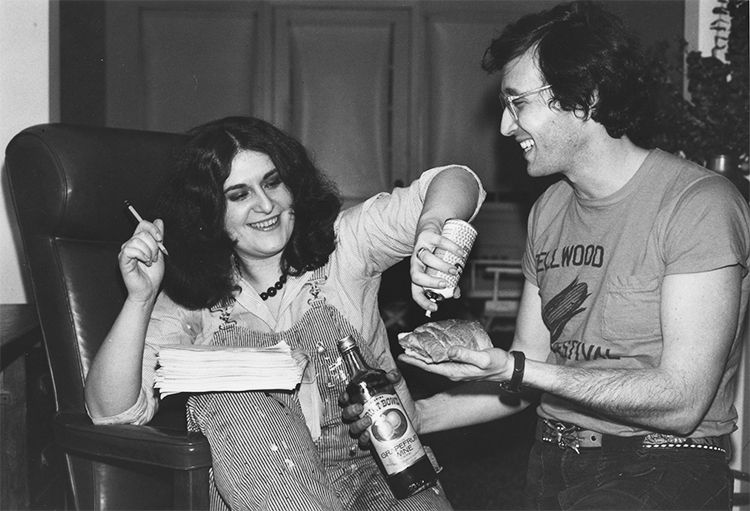
At home in Connecticut in 1975, with the manuscript of the first edition ofRoadfood.
Inside your white cardboard box, inscribed with a Emerge Bell silhouette, you will find a unmarried sandwich on thinly sliced bread; a cup of tomato plant aspic or potato salad; a half a deviled egg, wrapped in wax paper; a crisp cheese wafer (no bigger than a quarter) with a pecan exactly in its centre; and a cupcake or fruit tart . . . We honey the potato salad with its cucumber and onion crunch, and the sweet deviled egg that ineluctably conjures images of picnics long ago, just the cheese wafer makes us cry. So delicate, sadly out of style, with no place in the world outside this outré bakery, two little bites and it is gone; and yous get only ane in a box—a souvenir token of your visit to another era.
—"Emerge Bell,"Roadfood (1980 edition)
JANE STERN—neé Grossman—and Michael Stern were born, respectively, in New York Metropolis and Winnetka, Illinois. They met and married while doing graduate piece of work at Yale, having had their first date at Frank Pepe Pizzeria Napoletana; soon later, they published the beginning edition of their landmark American travel guide,Roadfood. The volume was amidst the first to care for regional American cuisine as worthy of serious report and serious writing. And yet the Sterns were never remote or overly pedagogical; writing in her introduction to their 1984 cookbook,Foursquare Meals, Yard. F. K. Fisher described their attitude as one of "love and respect" for homegrown food and tradition.
Although they have received several James Beard Foundation Awards and publish a new edition ofRoadfood every iii years (there is too a pop Web site), their xxx-plus articulation titles comprehend all facets of what they like to telephone call cultural anthropology: truckers, Elvis worship, "sixties people," Roy Rogers and Dale Evans, and Hummel figurines. TheirEncyclopedia of Bad Taste (1990) manages to combine several of the above, forth with fuzzy dice, Russ Meyer, and leopard print. ForThe New Yorker, the couple has written about balderdash riding, novelty toys, and Iowa radio homemakers. Michael has also written on Douglas Sirk, and Jane has published accounts of her life as an EMT and tarot reader. In 2007, they released the memoirTwo for the Route: Our Love Affair with American Food. In that location'southward likewise the 1979 novel,Friendly Relations; both groan when it is mentioned.
Although the Sterns divorced in 2008, they continue to work together and publish under their joint byline. Until two months ago, they lived in neighboring towns in Connecticut. (Michael has since moved to S Carolina.) For this interview, I met with them individually, at each 1's abode, so together, at Jane's firm in Ridgefield. We enjoyed white-clam pizza, water ice cream, and a cruller they had recently discovered at a nearby doughnut store. Both are animal lovers—they have written on bird owners, dog shows, and horses—and on each occasion we were joined by several pets, including Jane'southward French bulldogs and Michael's parrot.
INTERVIEWER
How did you two first meet?
JANE STERN
Nosotros were both at Yale, and Michael was getting his Ph.D. in art history.
MICHAEL STERN
Hoping to go—I never got it.
JANE STERN
You lot were in the process of getting information technology. Run across, nosotros're already editing each other. He was in fine art history, and I had arrived at Yale to study art, been accepted, shown up, and when I got at that place and went to register the first mean solar day, they said, Oh, we don't accept any space for yous. Information technology was the pinnacle of the Vietnam State of war, and they said, We accepted all these men students, and nosotros assumed that many of them would have been drafted, and none of them were. And I said, Accept you lot ever met an art student? They'd sooner, like, shoot off their penis than go to Vietnam. So I institute a temporary job at the slides and photographs collection—
MICHAEL STERN
On High Street.
JANE STERN
They assumed that, being a painter, I knew art history. Whereas I was like, An Etruscan slide, all right, that goes with Jackson Pollock. I'd just throw them in anywhere. Anyway, I was sitting at my desk-bound eating an orange snail—remember that expert pastry shop—
MICHAEL STERN
The Danish pastry shop.
JANE STERN
—across the street, and looking pissed off, which I was, a lot. All the art history students looked similar pear-shaped nerds, and Michael walked in.
MICHAEL STERN
I had my leather jacket. I was looking existent badass in those days—
JANE STERN
And your Wayfarer sunglasses, and you lot were tall. And I looked upwardly from my orangish snail, and I said—you know what I said, my first words?
MICHAEL STERN
Yes.
JANE STERN
I said, Are you a Scorpio? And he is.
MICHAEL STERN
And I am.
JANE STERN
But this is 1968 and that was the coolest pickup line in the globe.
MICHAEL STERN
Then I said—I was very involved with the film society at Yale, then I said, In that location's a documentary about—
JANE STERN
Hawks.
MICHAEL STERN
—Hawks, do y'all want to go see it? And Jane idea it was about birds, because she knew goose egg about moving picture.
JANE STERN
Howard Hawks.
MICHAEL STERN
And so we just started dating, pretty quickly.
JANE STERN
Yep. Or fucking or eating or doing something in the realm of dating.
MICHAEL STERN
I don't call back—what did we practise so?
JANE STERN
Well, you were living on Edwards Street.
MICHAEL STERN
Oh my God, yes. In that horrible apartment.
JANE STERN
All I remember you doing, basically, is smoking dope and watching movies.
MICHAEL STERN
And call up, I painted the windows black, so I could scout movies all day?
JANE STERN
Aye. And I remember you had a cardboard toilet-paper curl that yous wrapped in foil.
MICHAEL STERN
To make a pipe. Well, I didn't have a regular pipe. I did a lot of dope in those days. Lots of dope.
JANE STERN
Oh yes. I remember one of our offset dates we drove to Lincoln Center. Information technology was some movie—
MICHAEL STERN
It was the New York Motion-picture show Festival.
JANE STERN
Right. And I'm certain you lot were high on something only you were only talking nonstop, and I idea, My God, this guy is like Brendan Behan—nonstop poetry. And it turned out you were quoting verbatim the script from Valley of the Dolls.
MICHAEL STERN
Yes, considering I one time had a very interesting acid trip where I dropped some acid that was mode stronger than I thought information technology was going to exist in the subway in Chicago, and past the time I got out of the subway I realized, I'm not capable of doing annihilation, and so I merely walked into a picture palace where Valley of the Dolls was playing. And I saw it like vi times in a row. And to this mean solar day, lines from that movie—
JANE STERN
Practise you remember whatever of the lines?
MICHAEL STERN
"French subtitles over a bare lesser don't make it fine art."
JANE STERN
I had no idea what he was talking virtually. But y'all opened many new worlds for me, because I thought movies were Ingmar Bergman and Fellini. And I realized John Wayne movies could exist worth my fourth dimension. Michael was from the Midwest, and I didn't know anybody who was. Everybody I knew was a Jew from New York who went to a progressive prep school and sang Woody Guthrie songs.
MICHAEL STERN
I had a driver'due south license.
JANE STERN
You had a motorcar.
MICHAEL STERN
And a automobile.
INTERVIEWER
Which would become such an important part of your lives!
JANE STERN
Yep! And you had money because you were on a Woodrow Wilson Fellowship. They really paid you to go to schoolhouse, unlike the residual of us, who paid them. And yous wore a black leather jacket and you lot had tattoos—again, this is 1968—and y'all were simply very badass . . . for somebody who was getting a Ph.D.
MICHAEL STERN
In art history.
INTERVIEWER
Neither of you had a "writing" background then.
MICHAEL STERN
My get-go significant bunch of writing was in Russian, because I was studying Russian in high school, and I was editor of our Russian magazine—I don't know if anyone wrote for information technology other than me! Merely when I went to higher, I started writing motion picture criticism. There are two authors who accept influenced my writing the near. One of them is Andrew Sarris, The American Movie theatre. In fact, he became my adviser when I finally left Yale for the film history Ph.D. programme at Columbia. His way of evaluating film—even though information technology's way dissimilar than evaluating food—actually set the gears in my mind in the right way. And then Seymour Britchky, similarly, with food.
JANE STERN
I didn't abound upward writing formally. But, actually, the first book either of us wrote was past me—the truck-commuter book, Trucker: A Portrait of the Terminal American Cowboy. Why I thought I could write a volume I have no thought, just in those days, you could but say, I'thousand a writer, and be a author. Unlike at present, when information technology'south virtually impossible to get anything done. Michael had left Yale and gone to Columbia, and I had stuck it out at Yale and graduated, in 1971, with a master's degree in art. For my mother, equally for every Jewish mother of her era, the greatest thing her girl could do was either marry a doctor or become an simple-school teacher—and then marry a doctor. But I never liked children and I never wanted to be an unproblematic-school instructor.
Anyway, Michael and I had already married, and my female parent was at her wit's end about the fact that she had just paid for 8 years of school and I was doing near nil. Our agreement was that I would bulldoze into New Haven one time a week and become to the jobs department where they had iii-by-v alphabetize cards with jobs for graduates. I went and I went and nix, zilch, nothing. I was unmotivated, I didn't want to exercise anything except hang around with Michael and eat and play volleyball. Only betwixt New Haven and Guilford, where we were living, which was about twenty miles away, I'd end at a truck stop and take a cup of coffee, just to unwind from the cracking labor of looking at index cards. And while I was there, I was looking at these truck drivers, and I idea, Jesus Christ—these are cowboys! Because back then especially, truckers actually had that cowboy matter going. And then I would sit in the truckers-just department, and I'd talk to them. Every single one of them thought I was a hooker, simply that was all right, I didn't care what they thought I was. And I became fascinated with them and just kept talking nearly them to Michael. And then, coincidentally, there was an early version of Kmart, chosen Mammoth Mart, in Guilford, a store with cheap crap in information technology, and they had inexpensive crap LPs, and there was an LP called "I'1000 a Truck," written by Ruby-red Simpson, where he sings equally an anthropomorphized truck. Information technology was similar, Aw, wait at that beautiful footling pink truck next to me with the mud flaps, you know? And I merely loved it.
So a friend sent me to her editor in New York, and I said, I want to do a book about truck drivers. And they said okay! They gave me an accelerate, and Michael and I went on the route following truckers all the hell over the place. Trucker was very heavy on photography, which Michael did three-quarters of.
INTERVIEWER
Was it out of your comfort zone?
JANE STERN
Oh, yes. I was terrified of the truckers, I was terrified of the trucks, I was terrified of the truck stops, but there'south a real attraction-repulsion when you're phobic. I always loved bad boys, fifty-fifty though I was the world'southward biggest goody-goody. I mean, I never smoked a articulation in my entire life, I was always scared of my ain shadow, but I call back that's 1 of the things that appealed to me nearly Michael. He was fearless. Too fearless, actually.
INTERVIEWER
I imagine you've wandered into some dicey situations.
JANE STERN
Oh, yes. Allow me tell you lot 1 story. It was early on, and Michael and I were on the road, going from i bizarre situation to some other, and our hobby was visiting prison gift shops. We used to collect a lot of folk art and outsider art, and back in the day, some of the prisons would actually give prisoners free rein to craft their own things. They would brand lamps and sculptures and all kinds of things, and some of them were bright. They were absolutely fabulous! Although, nosotros lost some friends giving them prisoner fine art as a nuptials gift. And prisons terrify me—just again there'south that attraction-repulsion, and something voyeuristic, too. Whenever we would pass a prison house, we'd say, Allow's become to the gift shop, and dorsum then, at that place literally were gift shops.
So one day we were driving through Kansas, and there's a sign for Leavenworth penitentiary. Michael says, Oh my God, information technology's the female parent ship! It's going to exist the gift shop of all gift shops. And then we follow the signs, and we drive up to a huge circuitous with those barbed-wire loops—a very unpleasant-looking place. We pull up to a gatehouse and sit there for a while until we realize nobody's there. Then nosotros drive around and there's some other gatehouse, and this fourth dimension the arm is up, but again at that place's nobody there! Finally, we come upon a parking lot where we come across a couple of cars, so we assume the gift shop must exist nearby, and park, and there is a metal door in a big brick wall. We walk up to it, and nosotros open the door . . . and information technology's the chiliad—filled with prisoners! Staring at united states. Michael kind of hangs back at the door, but I say, Excuse me, only could you tell me where the gift shop is? There'southward dead silence, and finally this prisoner says, There own't no fucking gift shop, lady! And I say, Oh, thanks. And nosotros leave, and we close the door, and we drive abroad, and to this day, it'southward similar, What? And I even so have no explanation for it. I know it's like saying aliens stuck an anal probe in my ass and took me upward to the spaceship. Only, I swear to you lot, that happened.
INTERVIEWER
When you went to the souvenir shops, and, as you lot say, a lot of the things they made were genuinely beautiful, or at least interesting—
JANE STERN
Non the Leavenworth gift shop.
INTERVIEWER
Well, no. But did it make y'all lamentable? As you say, a part of information technology is voyeuristic, and a part of it is truly enjoying the dazzler of it, but does a part of you experience the hurting of it? Is it hard to be in the souvenir shop, is it difficult to handle the items?
JANE STERN
It was a mixed thing because I thought, God bless them, they're in a crafts shop making something, instead of in lockdown, slowly going crazy. Basically, every creative person is nuts. I think that'due south kind of a safe blanket argument. I know every bit an artist or writer—any creative thing I am—and for other friends of mine who piece of work in similar fields, the only time nosotros ever get a hundred percent out of our heads is when we're creating. So I like to hope that in the moments these guys are creating, they're non in prison house anymore.
INTERVIEWER
When you started writing near road food, did you think information technology was of a piece with the folkways motion that was going on so?
MICHAEL STERN
If we didn't at the showtime, nosotros very quickly did. The year after Roadfood was published, we published Amazing America. And in Amazing America there are lots of folk-art environments and stuff similar that. I recollect when we admittedly started, when Roadfood was called Truck Stoppin', we weren't thinking that it had anything to do with pop culture or folk art, but as soon as we got on the road and started finding guys like Howard Finster and that guy in Wisconsin—
JANE STERN
—the guy who collected—
JANE AND MICHAEL STERN
—the oil rags—
MICHAEL STERN
—not only did nosotros very apace realize that that was our passion, merely I think it actually helped us, in some way, to get a perspective on the food nosotros were writing about. It wasn't just truck-stop food. Information technology was nutrient that was a cultural phenomenon too.
INTERVIEWER
And that led to Roadfood?
JANE STERN
Well, in doing that, we were eating in all these road-food places, which didn't have a name then. There wasn't the concept of "road food"—there were just these piddling mom-and-pop cafés, and we kept a little notebook of these places. So after the trucker book came out, and did very well, in that location came the usual publisher question of what was side by side. And I said, I think we should exercise a book called Truck Stoppin', and I remember the editor said, What's that? And I said, Places truckers eat. And so nosotros got a contract to practice that. Then our grand idea was to review every restaurant in America, which seemed similar a really easy thing to do, considering neither of u.s.a. had ever been anywhere. Michael had been to Chicago, and I had been to New Haven! We simply opened a Rand McNally map, and said, Like shooting fish in a barrel. Three years later, we were still on the route finding these places. We were and so sloppy. The principal affair is that we wanted to be together.
INTERVIEWER
Yous've written on such a wide range of topics—archetype American gourmet and comfort food but also the West, the sixties, music. How practice y'all choose?
MICHAEL STERN
You lot should see the ones we don't write! We have a file an inch thick of rejected ideas. And that was one of the great things virtually writing for Bob Gottlieb—he encouraged that. He wasn't like, Is this mainstream plenty to put in a book? The more than offbeat and wacky we could get, the happier he would be.
INTERVIEWER
Practise you have favorites?
MICHAEL STERN
Someone asked Otto Preminger which of his movies was his favorite, and he said, One always likes one's sickly children best. And I feel that way—both Sixties People and American Gourmet sold terribly, so I accept a existent soft spot for them.
INTERVIEWER
Did yous read Susan Sontag'southward "Notes on 'Camp' "? It seems like, straight or otherwise, you ii are dealing with the thought of military camp.
MICHAEL STERN
I hardly fifty-fifty knew what Sontag was talking virtually when I get-go read it. But I went back to it over the years, and information technology made more and more sense to me as I became somewhat more worldly. Merely I've never thought of what we do as campy.
INTERVIEWER
How do y'all make the stardom?
MICHAEL STERN
As I wait at our writing career, 1 of the seminal books in terms of understanding our sensibility is Elvis Earth. Because what we were able to do with that book—and it wasn't hard, information technology just came naturally—was to write a book that loves and respects Elvis, and even so has lots of fun with all the silliness of the Elvis earth. And what was astonishing almost that book was that intellectuals liked it and Elvis fans liked it, also.
INTERVIEWER
Just that's hard to do—to get the tone right, to convey warmth and affection and, at the aforementioned time, to write from a remove that isn't patronizing. The number of people who neglect at that is attestation to the difficulty.
MICHAEL STERN
And there were reviewers who looked at Elvis Earth or The Encyclopedia of Bad Sense of taste and assumed that we were being patronizing. It's a fair assumption, since that's the way most of that stuff is looked at.
INTERVIEWER
Judging from your books, you seem to like people.
JANE STERN
I've always been fascinated by people, and good at talking to them.
MICHAEL STERN
I'1000 not the almost social graphic symbol, normally. Merely what we have to exist able to practise is to walk into any restaurant—a palatial restaurant or the boondocks café or a diner or a truck stop—and talk with people in a fashion that shows we respect them. But I have to get find the other part of myself—the social, talkative, interested role. A lot of me would like to just sit around and read a book and not talk to anyone, ever.
INTERVIEWER
I was nearly struck by the wholly respectful, straight approach to Happy Trails, the Roy Rogers and Dale Evans biography.
MICHAEL STERN
The Roy and Dale book was unique and wonderful. Sometimes when you come across your heroes, you lot wish you hadn't. But they were such skilful people, such decent people, and they tried to alive such practiced lives, and did, really, as much every bit they could.
JANE STERN
They were true Christians—and I say that as only a secular urban Jew tin. As well, Roy Rogers was the single worst commuter I've ever met.
MICHAEL STERN
He was terrible! He drove like he was riding Trigger in a chase.
INTERVIEWER
When y'all write about food, it's always been pretty articulate that the food isn't entirely the indicate.
MICHAEL STERN
The matter you eat is but office of the large flick. This is why, while nosotros've done cookbooks, the cookbooks e'er have something else—they're not only recipes.
JANE STERN
Cultural anthropology.
INTERVIEWER
They're very much armchair cookbooks for me.
MICHAEL STERN
Occasionally nosotros get assignments from magazines to do stories that have none of that cultural context—just recipes. I observe that the most ho-hum thing in the world. And then far as I'm concerned, we could have blank space where the recipes are—although that probably wouldn't sell then well.
JANE STERN
See, that's why I hate celebrity chefs. Because there's no cultural context. The cultural context is but—
MICHAEL STERN
Them.
JANE STERN
—that they made a lot of money and a name for themselves. There'due south no looking beyond that. That's why I like cooks—flattop cooks, existent grill guys, pit masters.
MICHAEL STERN
Well, of course.
INTERVIEWER
That said, are there any nutrient people writing now you think are expert, or practice you not keep upwardly with it?
MICHAEL STERN
Honestly, fifty-fifty when we wrote for Gourmet and Saveur, I never read them.
JANE STERN
I don't think I've read the New York Times in fifty years. I find so much of the writing—in magazines and the papers, wherever—just regurgitation of what somebody else said. That's why I can't stand going to conferences! Just tell me something that somebody in the Times wrote five years agone, it's like, Where's the fresh thought? And I don't see a lot of that.
MICHAEL STERN
Yeah, that's an interesting question, because information technology's baroque—I gauge information technology's baroque—for somebody who makes a living writing well-nigh food to pay no attention to anyone else who writes about food!
INTERVIEWER
And yet you were involved in the early form of the Beard awards.
MICHAEL STERN
Actually, we gave out the outset, when they were the Cook'due south awards. We gave an award to James Bristles and ane to Julia Child.
INTERVIEWER
How did you lot become to know Beard?
MICHAEL STERN
When the kickoff Roadfood came out, he wrote a really nice review of it. He had a syndicated cavalcade at the fourth dimension for Universal Press Syndicate.
JANE STERN
And he called us and said, I honey your piece of work. Because back then, nobody was writing nearly regional American food. And Beard grew up in Oregon and was 1 of the first people to write near real American food.
MICHAEL STERN
He took u.s.a. out to restaurants, which was corking.
JANE STERN
Because we were such rubes. It turned out he'd played with me when I was a baby, and he knew my cousin Wally, an opera singer. M. F. K. Fisher was our other really big fan from that generation.
MICHAEL STERN
Nosotros got to know her because we asked her to write the introduction to Square Meals, which she did. Then nosotros were heading to California, and we called her.
JANE STERN
I have all my correspondence with her, which is so great. M. F. K. Fisher, Beard—those are writers. Those are original people.
MICHAEL STERN
That's for sure. But the others? Julia we were never friends with.
JANE STERN
Julia liked to throw dorsum a martini.
MICHAEL STERN
And she one time felt up my knee.
JANE STERN
I remember she said, It's and so refreshing to run across a human who isn't gay in the food earth! While she was grabbing your crotch!
MICHAEL STERN
But in general, the food world . . . it'south just then against our nature. We occasionally were invited to dinner. Nosotros went to a fabulous dinner at Judith and Evan Jones', with a bunch of pregnant food people, and nosotros were sitting at the table and they were all talking about how you lot can't get adept caul anymore. Nosotros had no idea what they were talking about.
INTERVIEWER
Given that yous've sometimes had to practice recipe books, which of you develops recipes and tests them?
JANE STERN
Well, basically neither of usa.
MICHAEL STERN
When we do those stories for magazines, they examination the recipes. Which is peachy.
JANE STERN
We usually become our recipes from someone. Like, for Square Meals, those were all vintage recipes.
MICHAEL STERN
We rarely, if ever, invent recipes. But a lot of the recipes you get from cooks around the state are terrible and need to exist tweaked. At i point, we hired recipe testers.
JANE STERN
We had actual cooks, and they would make the recipe and so come over and show us the corrections.
MICHAEL STERN
I think that was when we were writing our syndicated column for Universal Printing Syndicate. It made life easy, but when yous don't do it yourself, information technology's not exactly the mode you would do it.
JANE STERN
I'm non a chef. I'thousand a dwelling cook at best.
MICHAEL STERN
No, neither of us is the type of person who cooks only for the pleasance of cooking.
INTERVIEWER
Yet the food books have been such a abiding between other topics, and the Roadfood book is in perpetual flux, since new editions come out every few years.
MICHAEL STERN
Luckily, I love writing! For me, information technology is the i surefire tranquilizer. If I'thou really stressed with tons of stuff to do, the one thing that makes me relax is if I tin can sit down and write something.
INTERVIEWER
How do yous continue a deathwatch on a lot of these older contained places?
MICHAEL STERN
It'southward so inevitably frustrating, because we write the volume, and we e'er enquire the publisher what's the terminal day nosotros can take something out or make a change. Then mayhap three or 4 weeks prior to that, I'll either call or exercise some kind of a Web search, to only make sure things seem to be every bit we wrote they were months before. Only always, when a book comes out, there are three, iv, five, mayhap even x places that either don't be anymore or, worse, yet exist but have totally inverse their bill of fare or gotten horrible in some way or another. But that'southward impress.
INTERVIEWER
When yous practise the Roadfood reviews, you mention, for instance, that you, Jane, don't care for shad roe. Whereas you, Michael . . .
MICHAEL STERN
I'grand pretty omnivorous.
JANE STERN
Omnivorous! You'll effort anything—like pig'due south ears.
INTERVIEWER
And all the same the "we" tries everything.
MICHAEL STERN
There are a few occasions where we do make mention of the fact that, for example, Jane won't put a condiment on a hot canis familiaris.
JANE STERN
I hate ninety percent of everything that's served. Here's a brusk list of things I won't swallow—oysters, raw oysters, salmon, any offal, any organ meats—
MICHAEL STERN
You like liver.
JANE STERN
—game, I can't stand up game, anything bitter like broccoli rabe or a cocktail with bitters in it. Basically my main food groups are—
MICHAEL STERN
Cheese.
JANE STERN
—hot turkey sandwich, cheese, and cake.
MICHAEL STERN
I practice everything else.
JANE STERN
I don't similar cold cuts, I don't like sandwiches, you lot know, when they're this big—
MICHAEL STERN
In that location are sandwiches you like.
JANE STERN
—information technology's like I tin't open up my mouth wide plenty to eat the affair.
MICHAEL STERN
You're not really a sandwich person.
JANE STERN
No, I hate sandwiches, basically.
MICHAEL STERN
Hot sandwiches with gravy are a different story.
JANE STERN
And I similar grilled cheese and steak.
INTERVIEWER
You must have known going in that there'd be a lot you wouldn't like to eat.
MICHAEL STERN
When I outset met Jane, she ate cheese pizza. She wouldn't add any ingredients, she just ate apparently cheese pizza, or macaroni and cheese. And so y'all started experimenting with cooking. You lot used to brand that horrible shrimp back-scratch. Well, it wasn't horrible—
JANE STERN
No, it wasn't.
MICHAEL STERN
It was kind of suburban shrimp curry.
JANE STERN
Well, maybe information technology was pretty horrible, because I didn't know that you were supposed to put flour or cornstarch in cold h2o, and so add together it gradually to the liquid—so instead I would just throw in a cup of flour, and and so spend hours mushing the lumps out of the thing.
MICHAEL STERN
But yous spent a lot of time teaching yourself to cook.
JANE STERN
I did.
MICHAEL STERN
Because you lot never cooked, nor did your mother.
JANE STERN
No, we had a housekeeper. And my mother was the about hideous cook. When I moved to New Haven and I lived at that communal place—
MICHAEL STERN
Rochdale Co-op.
JANE STERN
—everybody took turns cooking the dinner for all of us one time a calendar week, and when information technology was my turn, and I had no thought how to cook anything, I called my female parent, and she said, I'll call the pizzeria and use my charge bill of fare, and they'll bring twenty pizzas over.
I besides did false cooking when I was trying to get you to woo me.
MICHAEL STERN
When you claimed you had made the baklava?
JANE STERN
He said in one case that he liked baklava, and I call up walking all over New Oasis until I found baklava, and and so I put information technology in a pan. I pretended I had made it.
INTERVIEWER
How virtually the more research-based books, like American Gourmet? That must have required some time in the archives. Which of yous likes to do research?
JANE STERN
I would say both of united states of america. And I do have to footnote that past saying when we did a lot of our books that required a tremendous amount of research, like the Encyclopedia of Pop Culture, Way Out West—
MICHAEL STERN
Bad Taste—
JANE STERN
—it was all precomputer. Nosotros actually hired folklorists at Bowling Green State University to do research for us. Because we could just do so much.
MICHAEL STERN
Nosotros went to libraries and went through microfiche and all that kind of stuff. But for a lot of those big encyclopedic books nosotros had researchers and photo researchers. I don't recollect specifically, just there were probably many subjects, peculiarly for Bad Taste, that we just couldn't become anything on.
JANE STERN
Now it'southward simply so laughably easy. Y'all put leopard-print fabric in Google, and twenty m articles come back at you. And so, information technology was like mining for diamonds. I think I may love researching a lilliputian more than yous practise. Like, I would literally thumb books and yellow pages—
MICHAEL STERN
You may dear it more, just you also take a fine-tuned vision. Y'all run into stuff I would gloss over.
JANE STERN
That's true.
MICHAEL STERN
Even traveling through a boondocks, Jane volition see the littlest sign in the window that says butter burgers that I would miss.
JANE STERN
Or selection up some weird affair that somebody's wearing. Like clues.
INTERVIEWER
You take a good heart.
JANE STERN
I accept a very good center.
INTERVIEWER
And what's your particular strength, Michael?
MICHAEL STERN
I don't know. Exercise I accept 1?
JANE STERN
I think you are a hundred times meliorate than I am at describing nutrient.
MICHAEL STERN
Yes. I'm pretty proficient at describing nutrient. This is style oversimplifying it, but you get me the cloth and I can draw it.
JANE STERN
But I'll say, It'due south got a lot of rosemary in information technology, and you lot don't notice that.
MICHAEL STERN
Aye, I can identify like three flavors. I could tell you if information technology's salty or it's peppery.
JANE STERN
Right. But you're a better nutrient writer than I am.
INTERVIEWER
Practice you lot feel that when you started writing, y'all were part of a counterculture?
MICHAEL STERN
Yes, and that's been, in many means, characteristic of our career from the first. We have always written best when we're writing against something.
JANE STERN
As contrarians.
MICHAEL STERN
As contrarians. Similar, when we first did Roadfood—this is putting it as well strongly—but our enemy was Gourmet magazine. Everything that Gourmet stood for, we were against.
JANE STERN
Just the word gourmet.
MICHAEL STERN
Yeah, the very word.
JANE STERN
The idea of elevated, fine cuisine.
MICHAEL STERN
I honey The Encyclopedia of Bad Taste because information technology'south épater le bourgeois. I retrieve we thrive in that state of affairs.
JANE STERN
That's why we're not part of foundations, boards, committees—
MICHAEL STERN
We're very comfortable equally outsiders. And even if we're not actually, if we tin can feel that way, nosotros're more productive and happier. There's a story about Douglas Sirk, that after False of Life, which was the near successful film in the history of Universal Studios up to that time, he got carte blanche. He was finally costless of those crappy melodramatic scripts, he was gratuitous of Rock Hudson, he was gratis of Universal Studios—and he had a nervous breakdown and never fabricated some other moving-picture show. Because he thrived on working confronting the material. That's not exactly what we're doing, but I tin can relate to it.
INTERVIEWER
Is it nonetheless heady? Do yous think in that location are even so places to exist discovered?
MICHAEL STERN
Without a doubt.
JANE STERN
Oh my God, without a dubiousness.
MICHAEL STERN
At that place are whole regions, or types of food, that we're still learning about. What did nosotros know about creemees? We used to drive past creemee stands in Northern Vermont and pay no attention to them. I had no idea there was a whole culture of creemees out at that place. And this was something nosotros but found two months ago.
INTERVIEWER
What percentage of the places you go to are duds?
MICHAEL STERN
Our radar'southward gotten ameliorate, tips have gotten meliorate—our percentage at present is way meliorate than 50 pct. I call up, out of iii restaurants we go to, two are going to pan out.
INTERVIEWER
And you probably know what to social club once you're there?
MICHAEL STERN
Yes. Either because we've gotten a tip or only because we know more about regional cuisine. And so, if nosotros're in Northern Minnesota and we run into hot beef on the menu, we'll know it's not merely hot beef, information technology'southward hot beef, which in that part of the world means roast beefiness, gravy, white staff of life, and mashed potatoes. Or, for example, the first time we went to the Eastern Shore of Virginia, I remember paying no attention whatsoever to the fact that there were sweet potatoes on the card. And merely a couple of years ago, we did another story about it, did some research, and realized that that'southward the almost fertile sweet-potato-growing surface area in the country, and in fact at that place are six or 7 different kinds, and if a eatery is offering sweet potatoes, it's probably well worth ordering. Back when we started, if you had asked me what the hereafter of American food would be, I would have said it'due south going to be deluxe chefs and McDonald'southward. But in fact, at that place has been sort of a culinary renaissance in this country and, especially, of American food, which, when we started our book, was not so well recognized, was not given much respect. We had to convince our editor that there was plenty food in this country to fill a guidebook. Which sounds preposterous right now.
INTERVIEWER
In many ways, you were progenitors of that genre, which is now packaged in shows like, say, Guy Fieri's. You must take a certain ambivalence.
MICHAEL STERN
Of course! In fact I gave a talk at the Greater Midwest Foodways Alliance, and the title of it was "Volition Success Spoil Regional Food?" Fortunately for united states of america, nosotros've never been and so popular that we tin have that level of influence. The almost glowing review dramatically changes business organisation, yep. We've heard from places that a lot of people come through in the summer with the guidebook in paw, and they're very grateful, and that's nice. But it'south not the same every bit a eating place being on Guy Fieri'due south testify, in which case information technology's suddenly overwhelmed, they hire new chefs, they streamline the carte, and information technology's not the same place anymore. On the other hand, they're being recognized. They're making money.
Nutrient, on television in particular, has become nigh like what professional wrestling used to be. It'southward so vulgar and disgusting—people pigging out on the biggest hamburger always! I just heard the statistic that half of all millennials consider themselves foodies.
INTERVIEWER
And what does that mean to them?
MICHAEL STERN
Exactly. Information technology means they love to swallow a lot of ribs. And perhaps that they fetishize the "authentic." That's ane of the things I have the virtually pride in, of what we've done. I think we're actually respectful of what we write about because we dear it. When The Encyclopedia of Bad Sense of taste came out, nosotros had to explicate that nosotros beloved this stuff! We're not maxim this is bad—it'southward that bad sense of taste is so wonderful. And once we explained that, almost people got it. The Encyclopedia of Bad Gustation is not about things that are horrible.
JANE STERN
Think "A for Amish"?
MICHAEL STERN
Yes.
JANE STERN
Nosotros wanted to requite an entry to the souvenirs of Amish country—
MICHAEL STERN
Because there's so much Amish kitsch.
JANE STERN
—but we realized we hated it and so much, it wasn't fun to write virtually. There was nothing charming about it. And it just came out ugly and angry! We had to cut it.
Well-nigh two weeks before The Encyclopedia of Bad Taste came out I had a meltdown, where I said, We accept to withdraw information technology from publication. It's but so mean. Nearly people saw—thank God—that information technology was more of a celebration of outsider culture, not New York tastemaker culture, merely I recollect the publisher threw this huge party for information technology in Las Vegas. This is when publishers were very lavish—you cannot imagine how much money they spent. It was at Caesars Palace, and they had hired bodybuilders, accordion players, cheerleaders, bikers, Elvis impersonators to cruise around the party. And the piano accordion player was this sweet niggling onetime man, and he had been so proud to be hired, and he didn't know that it was in bad taste until he got to the political party. And he was ripped. He said, I love the accordion. I love Lawrence Welk. Information technology's cracking gustation. I simply wanted to die. Then at that place were people who, I think, did get hurt, and that was not pretty. And so at that place was the antipodal, where Michael and I were sued for x million dollars past a disgruntled biker. Thank God that got dismissed, or Michael and I would be in Leavenworth making crafts!
INTERVIEWER
You wrote a novel, Friendly Relations.
MICHAEL STERN
Oh, God.
JANE STERN
Remember, you had pneumonia.
MICHAEL STERN
Yes. It was the wintertime of 1978.
JANE STERN
Right, and in that location was a huge blizzard, and nosotros could hardly beget the oil. It was like Oliver Twist. We were covered in blankets and shivering and had no money. The phone rang and information technology was our publisher, the devil incarnate. He said, This is David. Do yous want to make a million dollars? Michael's dying of pneumonia, and then we said, Yeah! What do we have to do? And he said . . . What were they called—"boovies"?
MICHAEL STERN
Boovies, yep. Somebody would take a flick idea, and so they hired someone to write the book, so that would come out first.
JANE STERN
Information technology was ridiculous. David said, You lot have to write the volume, we're going to pay you a meg dollars, then as soon as we make the flick, we'll make a million dollars off that. And then nosotros said, Where do nosotros sign up? And he said, Here's the situation. Well, you know the plot, the idiotic plot, the secretarial assistant of state—
MICHAEL STERN
The secretary of state's son and the daughter of the premier of Communist china.
JANE STERN
Correct, basically keep a road trip. And they run across the world's biggest ball of string. It was only hideous. And David kept maxim—I think this was when Scruples was existence made—Put in name brands of watches. So there is a scene where they're shopping in Bendel's and they wait at Patek Philippes.
MICHAEL STERN
Oh, and call back Linda?
JANE STERN
And the mother-in-law?
MICHAEL STERN
While we were sending in chapters, we got calls from the beach in Hawaii where David's married woman, Linda, would have editorial suggestions for us. And and then Linda's mother would get on and say what we had to do to change this function or that part.
INTERVIEWER
Was the process at all fun and absurd, or merely horrible?
JANE STERN
It was horrible. But the thought of all the money nosotros were getting—
MICHAEL STERN
In the end, we got 9 thousand dollars.
JANE STERN
Which was great!
MICHAEL STERN
It was more than than we had to offset with.
JANE STERN
Yeah, simply it was not the large check nosotros'd expected. And then Jason Epstein said it was so bad they wouldn't publish it!
MICHAEL STERN
But they did. There were a couple of those books, those boovies. Who'south that guy, what's-his-name . . . the editor at Knopf.
JANE STERN
Gordon Lish. I think he did it pseudonymously, because he was smart.
INTERVIEWER
At some betoken you settled on the royal we, the Stern we. Who does the actual writing? What's the process?
JANE STERN
Whoever doesn't take writer's cake, whoever isn't lying on the couch, saying, I don't feel well, writes. At that place were inevitably some things that one of united states of america was more passionate most. There are whole articles, and probably even some books, past Jane and Michael Stern that only one of united states of america wrote. One of us said, I'll practise it. Or, You lot practise information technology, I can't stand up information technology. Or I'd outset information technology and it was incredibly shitful and then Michael would take over and it was ameliorate. I mean, at that place was a time I started stabbing the manuscript. We used to fight like cats and dogs nearly it.
MICHAEL STERN
Yeah, it took a while to go . . . harmonious. Because one has to subjugate a lot of ego when one works with another person.
JANE STERN
I don't know if we went to marriage therapy, or how we decided at some signal to be polite with each other.
MICHAEL STERN
I think we just figured that one out, that you couldn't scream or say, You lot idiot, this is the stupidest thing I ever read!
JANE STERN
Aye, I couldn't take a knife and stab the manuscript. Instead, I would say, Yous know, I recall maybe the first paragraph is a piddling weak.
INTERVIEWER
There'south such a consistent tone. Does one of you read over or rewrite the other, or do you just take a similar enough sensibility?
JANE STERN
When we wrote for The New Yorker, the editors would always try to figure out who wrote what. Information technology was very seamless.
MICHAEL STERN
I think we've been doing it and then long that in some ways information technology has go an entity.
JANE STERN
For Roadfood, we would spend so much fourth dimension in the car that we would talk everything out.
MICHAEL STERN
So it was near prewritten.
JANE STERN
Considering what the hell else are you going to do in the motorcar for twelve hours a day?
INTERVIEWER
And you must accept a similar humour.
JANE STERN
And sense of everything.
MICHAEL STERN
We often used to say that nosotros kind of raised each other, considering both of us had pretty crappy childhoods in terms of being taught how to live and what to do and how to run into things, and we really started figuring that stuff out, to the degree that we have, when nosotros got together. Nosotros developed a perspective, a sensibility, together.
JANE STERN
Blank slates. Even yesterday, we were at this fucked-up recording studio doing a radio spot, and nosotros were there five times longer than we needed to be, and I had this horrible lobster roll, and Michael texts me in the eye of it, Was that the worst lobster roll you've always had in your life?
MICHAEL STERN
You fell out of your chair laughing.
JANE STERN
I did. I can't tell y'all how many situations nosotros accept been in over the years—
MICHAEL STERN
Similar that time in Tennessee?
JANE STERN
When we went to see that Elvis fan. Nosotros were writing Elvis Earth. And we figured, Okay, let's just get a clichéd lazy Southern vignette. And when we were leaving, the guy handed me something and said, very courtly, Thank you for coming. It was a doll, and when you touched its shoulder, its penis would come out. So in situations like that, nosotros would autumn out of the house laughing together.
MICHAEL STERN
We see sense of humor in things that nobody else does. Once we were in Cincinnati doing Expert Morning Cincinnati, and the pope had died—
JANE STERN
We were supposed to have the first spot.
MICHAEL STERN
—we were supposed to have the first segment, but the pope had died, and Cincinnati's a very Cosmic metropolis, so we'd been bumped.
JANE STERN
We were in the green room grousing near how the pope had knocked united states off our lead spot in Cincinnati. Yous told a pope joke, and it wasn't even that funny, just . . . Well, have yous e'er had hysterical laughter?
MICHAEL STERN
In situations where you're non supposed to?
JANE STERN
They could hear us, on the ready. I could not stop laughing, and the producer came in and said, Get out! And as I was leaving, I was leaning against the walls laughing, and he came and actually shoved me into the elevator.
INTERVIEWER
In everything you lot do, there'due south this sense of complicity.
JANE STERN
Yes, admittedly.
MICHAEL STERN
I think that's what it feels similar.
JANE STERN
We were, and I recall still are—it doesn't thing what our marital status is—soul mates. At least, aesthetically.
INTERVIEWER
Did people flip out when you lot got divorced?
MICHAEL STERN
Information technology's difficult to say—
JANE STERN
I flipped out.
MICHAEL STERN
Other than yourself.
JANE STERN
I mean, it'south not like we're Brad Pitt and Angelina Jolie. Information technology's not like what we practice makes the top of the gossip pages.
MICHAEL STERN
My sense is that for people who similar our work, every bit long as we are withal doing what we practice, it'due south okay. Information technology wasn't as though, of a sudden, I was going to get-go writing nearly sports cars and you were going to start writing almost perfume.
JANE STERN
Exactly. They didn't love u.s.a., they loved our work.
MICHAEL STERN
Which is squeamish.
INTERVIEWER
I think people do think of you two as a friendly presence, a reliable presence that has been their guide on so many trips.
JANE STERN
And hopefully we still will be.
MICHAEL STERN
We didn't have kids, so our piece of work is similar our kids. When people go divorced, they aren't going to love their kids any less. It might be sad, et cetera, et cetera, but the kids are withal there, the work is nonetheless in that location.
JANE STERN
And in the aforementioned manner people see each other after they divorce, so they can keep a certain sense of an intact family, it's not a hardship for us to work together. It'south still the skilful vibe.
MICHAEL STERN
Because we practice still have that connection.
INTERVIEWER
How do you keep your hearts from getting broken, when places you love are constantly closing?
MICHAEL STERN
Oh, it's terrible. At that place are places that you only feel are going to go on forever, that have gone on forever, and and so of a sudden they're not in that location anymore. In that location was a place in Marshalltown, Iowa, called Stone'southward. It was the domicile of the "mile-loftier" lemon chiffon pie. Somewhere in my file, somewhere in 1 of those boxes, I take a picture, information technology'due south a postcard of their pie. That place had been there since the late nineteenth century, and they were starting to have troubles, and and then they went out of business organization. I don't know if I'yard and so much invested in it that I would cry over the loss of a identify, but it's terrible when that happens, and it does.
Source: https://www.theparisreview.org/interviews/6421/the-art-of-nonfiction-no-8-jane-and-michael-stern
0 Response to "Paris Review Art of Nonfiction I Do Not Like the Introductory Paragraph"
Post a Comment